The Spices at the Heart of Balinese Cuisine
Balinese cuisine has a particular flavour and at the heart of that is Base Genep, a complex spice mix, explained by Chef Heinz von Holzen.
A great Indian chef once remarked to me that in India, the flavour of curry blends changes every 50 km. To me, this applies not only to India, but also to Indonesia and other parts of the world. It seems to me that the closer a region is to the equator, the more spices are used.
Maluku, the famed Spice Islands of far east Indonesia, was obsessively sought for many years before they were ‘discovered’ by Portuguese sailors in the 15th century. Explorers like Christopher Columbus, Vasco da Gama, Ferdinand Magellan and Sir Francis Drake all dreamt of seeking a fortune there. In fact, one of the main incentives for Europe’s age of discovery was the avid search for these spices, easily worth their weight in gold then.
Spices like nutmeg, mace and cloves were used to camouflage the flavour of spoiled meat in the days long before refrigeration. It was also believed that these exotic spices had huge medicinal value. As far back as the 3rd century BC, the Chinese knew of cloves, and by the 4th century AD, fragrant cloves had reached Europe. Yet for hundreds of years, the world’s total clove production came from five little islands in the far east of Indonesia, Ternate and Tidore in the north, Ambon in the centre and the island group of Banda on the southern edge of the spice islands. Control over these spice-producing islands assured one immeasurable fortune, and countless lives were lost in the quest to possess them. But the introduction of refrigeration and British success in propagating nutmeg and cloves in Sri Lanka was to end the spice wars for ever. Even more astonishing is the fact that these indigenous spices to Indonesia were actually introduced into Indonesian cooking by Indian traders.
Of course, across the archipelago nation, the use of these spices in cuisine varies dramatically, and combined with local culinary traditions, fabulous, vibrant dishes have been born –and so often, the process starts in a stone mortar, with selected spices ground into a flavourful paste.
Visitors to Bali seem to have the mindset that Balinese food is invariably hot. Guidebooks to Bali also contribute to this belief by employing the adjective “fiery” to describe the local dishes. In my opinion, there are only a few Balinese dishes within the entire cuisine that would probably be too spicy for the Western palate. There are plenty of spices in daily use and some of them have very strong effects, but these spices are not normally mixed in with the food while it is being cooked. Rather, a ground mixture or spicy chilly paste (sambal) is provided on the side so that the diner may choose to add as much or as little as he or she wishes. Balinese dishes are not necessarily spicy, but rather ‘spiced.’
Visitors to Bali seem to have the mindset that Balinese food is invariably hot.
A visit to the local markets will help one become familiar with the great many varieties of roots, shallots and garlic used in every cooking. One important thing to keep in mind when choosing spices is that the appearance, aroma, flavour, texture and effectiveness of the spices are highly variable. Factors such as when it was harvested, the weather and the soil condition, among others will effect quality, so expect great variations and judge accordingly.
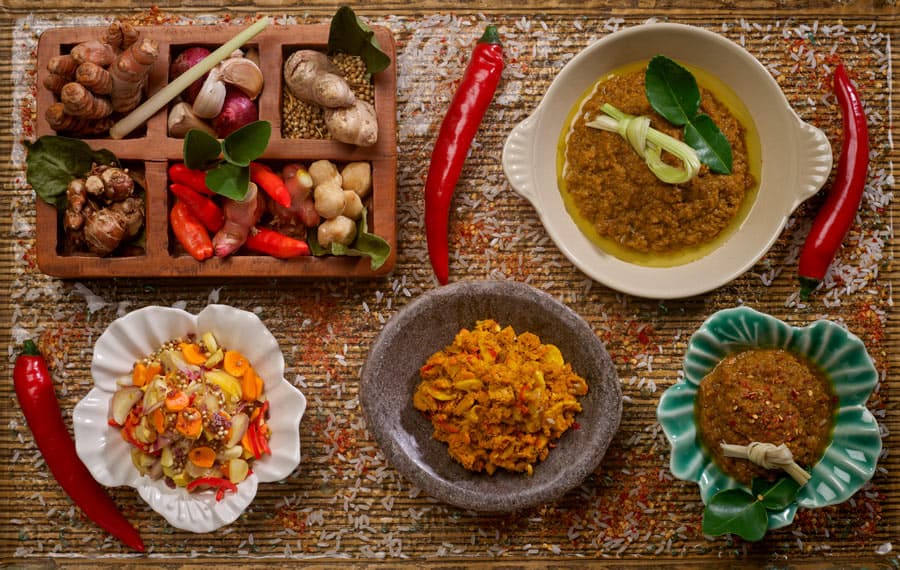
In Bali every cooking process starts with the grinding of various spices. The resulting paste is known as bumbu or base genep, which translates literally to ‘complete spice paste’. Base genep consists mostly of eight fresh and four to five dry spices: shallots, garlic, galangal, lesser galangal, ginger, turmeric, chilli, candlenut. In our restaurant, Bumbu Bali, we prepare five different spice blends: Seafood (base be pasih), Vegetables (base jukut), Chicken (base be siap), Beef (base be sampi), and a complete spice blend (base gede) that is used for pork, duck, lamb, i.e. meats with strong flavour. Each blend contains similar ingredients but they are blended in very different proportion to bring out the flavour of a particular protein or vegetable.
These base or bumbu, in their slightly various forms, are at the heart of Balinese savoury dishes; a recognisable flavour found at the heart of many traditional delicacies from bebek betutu (steamed or roasted duck) to babi guling (spit-roasted pork), lawar (minced vegetables).
Large scale ceremonies almost always translate into big feasts in Bali. In Jimbaran, in the southern part of Bali, preparation for such events begin with the helpers gathering in a central location, frequently the bale banjar (town meeting hall), the evening before, to chop up the spices. This process, known as ngeracik basa, meaning “mix the spices”, lasts about two hours, with a break for coffee and snacks in between.
If the ceremony is not a family affair, that is, if it takes place outside the home, it is strictly a male activity, although women are usually present to serve snacks and collect the chopped spices. The women have another duty. They cook the rice which must be ready by dawn the following day.
The men sit cross-legged on coconut leaf mats, either on the floor or on a raised table, in two long rows. They face each other with chopping boards, usually borrowed from the banjar, in between them. Each man brings his own knife, called a berang. It is usually large, almost like a cleaver, but with a very sharp point. The spices are delivered in woven coconut leaf baskets and are prepared as appropriate. Every helper knows exactly what to do because they have done it many times over and this for many generations.
Dressed in traditional formal Balinese attire consisting of a sarung with a sash tied around the waist, the men enjoy the opportunity for this social gathering. Often, a jug of arak (rice wine) or tuak (palm toddy) is passed around to liven spirits. The tek-tek-tek sound of the knives on the cutting boards can be heard from a long distance away and it is an unforgettable part of Balinese village life.
The men return home when the preparation of the spices is complete. They get a few hours of sleep and then meet again shortly after midnight to cut up and prepare the meat for the feast. In the south of Bali, it was in the past always turtle meat and in the other parts of Bali, it is always pork. The spices are mixed by one or more of the men who are acknowledged to be so-skilled. Many Balinese dishes have subtle flavours, but there is nothing dainty about ceremonial cooking. During a typical village ceremony, food is prepared for approximately 700 people, including the helpers and their families. For this purpose, at least 55 kg of spices would be used.
Here I share with you the recipes for two of the mentioned Balinese spice pastes, for chicken and for strong meats. You will notice how the adjustments in quantity of each spice also changes the appearance of the final paste.
Preparations:
1. Combine all ingredients except lemon grass, kaffir lime leaves, oil and water in a stone mortar or food processor and grind into a very fine paste.
2. Place ground ingredients in heavy saucepan, add remaining ingredients and simmer over medium heat for approximately 30 minutes, or until most water has evaporated and pasts takes on a golden shiny colour.
Note: Refrigerate spice paste overnight, then place chilled spice paste into an ice cube tray and freeze. Store frozen spice past cubes in an airtight container in the freezer and use as needed.
Discover authentic Balinese cuisine in a modern setting at Bumbu Bali Restaurant and Art Café Bumbu Bali | To find more cooking recipes, explore Chef Heinz von Holzen's Balinese and Indonesian Cookbooks.
Read Next
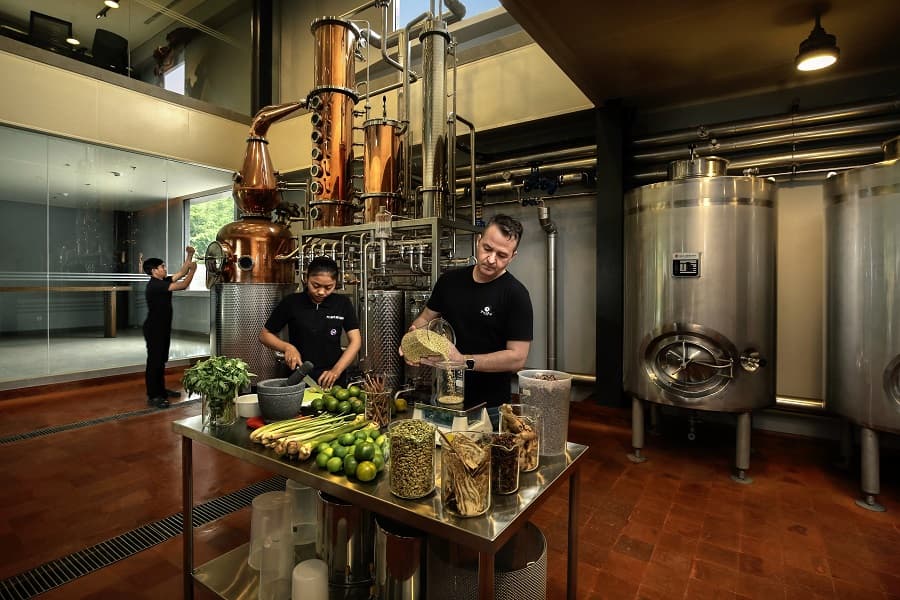
Island Distilleries: Bali's Growing Spirits Industry Explores Archipelagic Flavours
Bali has seen the rise of industrial-level island distilleries, producing high-quality products that are on par with renowned global brands.
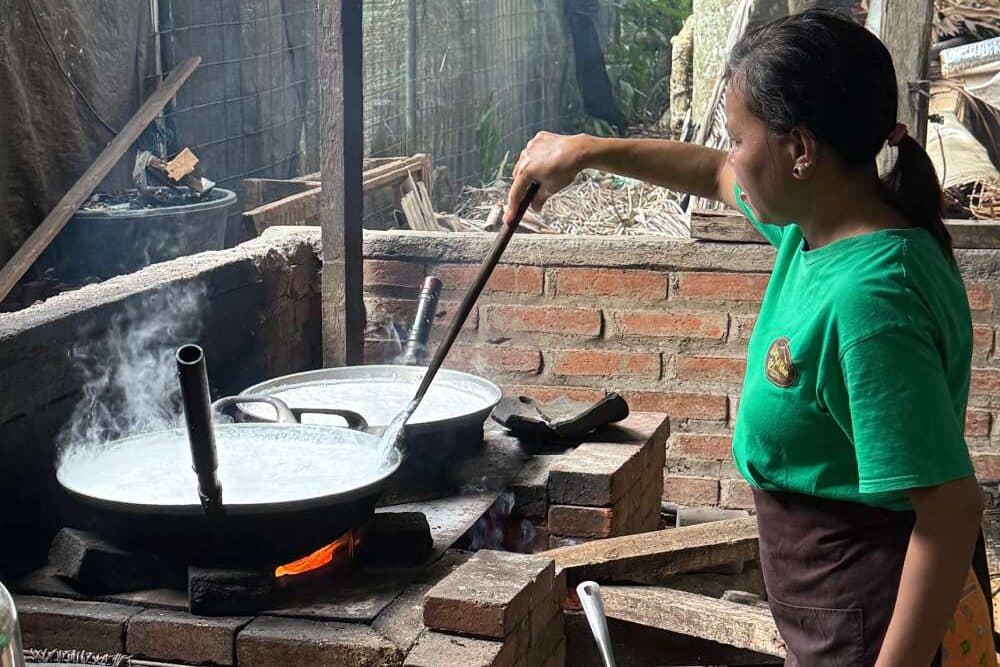
Nandusin & Tlengis: Bali’s Forgotten Flavours & Timeless Techniques
As the practice of nandusin has declined, so too has the availability of tlengis. Warung di Kebun tries to bring this forgotten dish back to life.
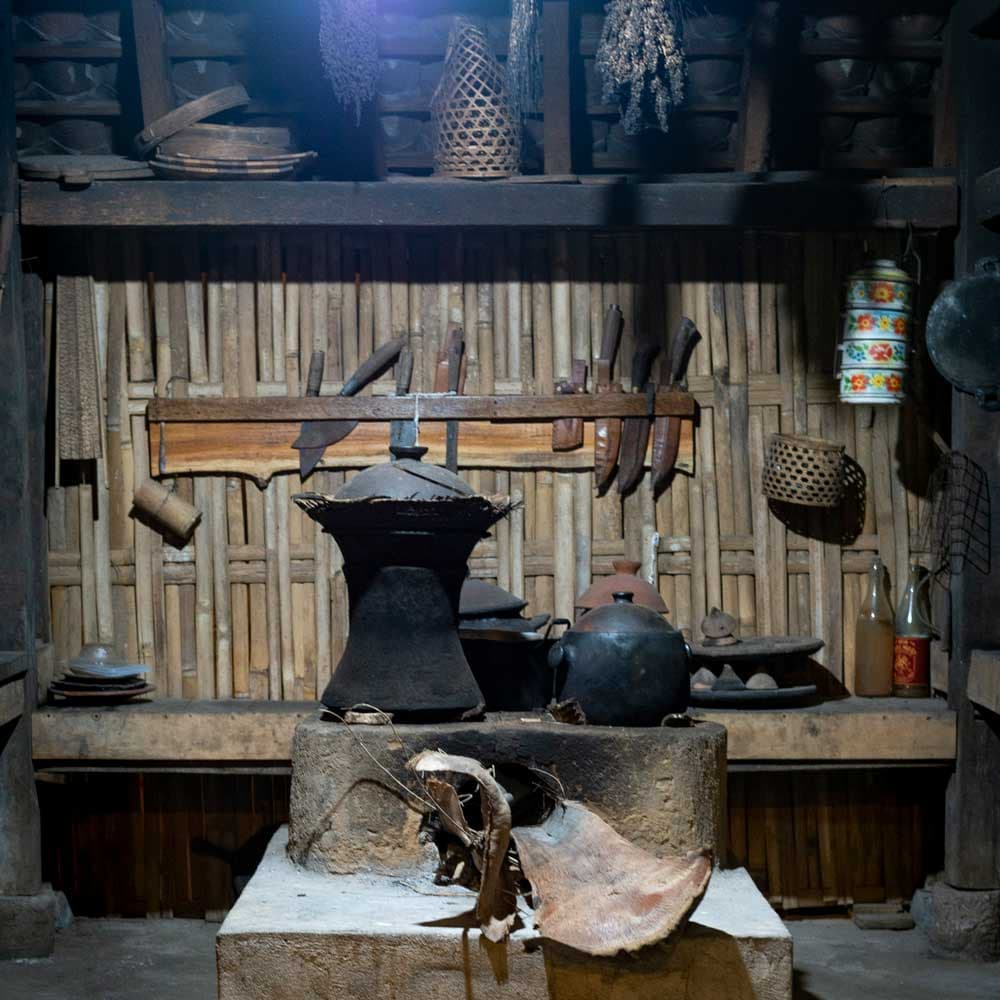
The Culture of Balinese Cuisine
In Bali, food and cooking are intertwined with philosophy, community and culture. Every bite contains within it a little lesson and discovery of the island of the gods.
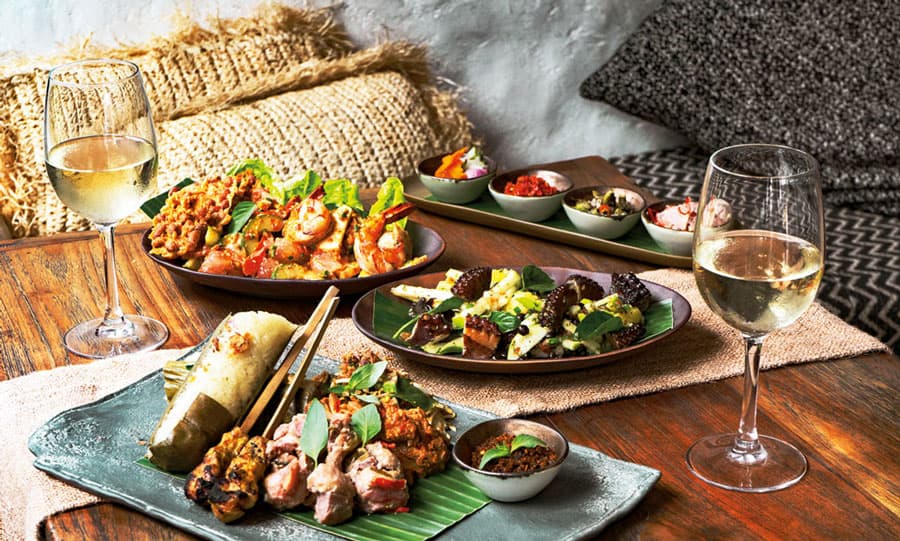
Feast Like a Local in Bali
Bali has always been known for its cultural diversity. Yet even with so much diversity, there is a single common thread running through the soul of the island. That is food!
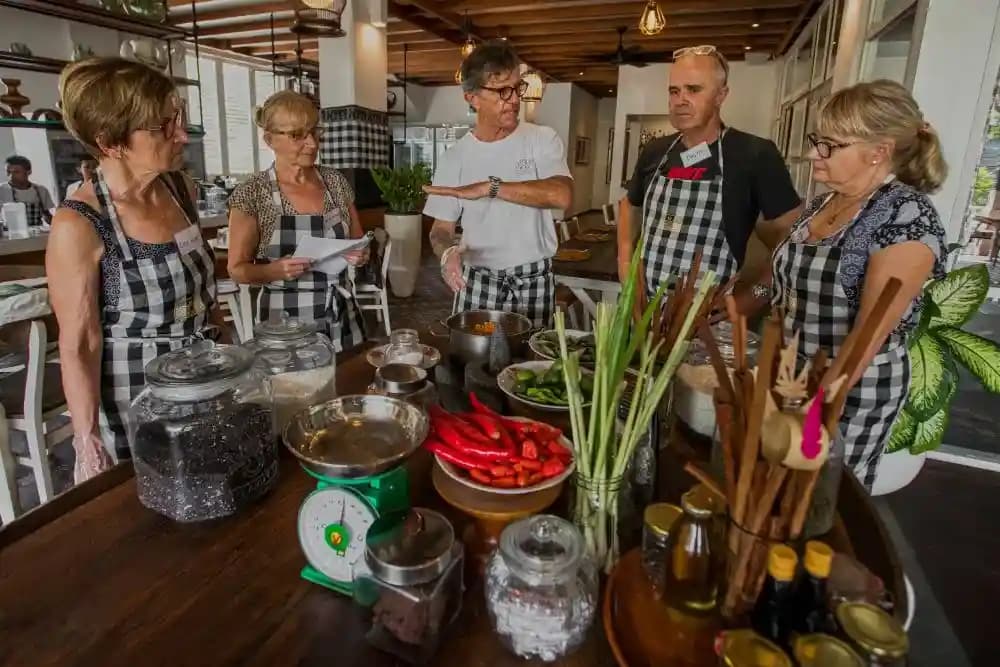
A Balinese Cooking Class with Chef Heinz at Art Café by Bumbu Bali
Join an intimate cooking class, learning authentic Balinese dishes, spices, and traditions in a hands-on experience at Art Café by Bumbu Bali.